













Ice is food in UK law, so your ice machine is food equipment and belongs in your food safety management system. But the regulations set no fixed cleaning interval. They require cleaning and disinfection “at a frequency sufficient to avoid any risk of contamination”. That is a standard you have to meet and be able to justify, rather than a date in a diary.
That distinction matters, because most of what you will read on this says the law requires a clean every six months. It does not. The six-month figure comes from manufacturer literature, not legislation, and if your water is hard or your bar is busy it may be nowhere near often enough.
Key takeaways
- Ice is legally food in the UK, so an ice machine is food equipment under Retained Regulation (EC) 852/2004.
- The law specifies no cleaning interval. It requires a frequency sufficient to avoid contamination, which you set and justify.
- Official council guidance puts the storage bin on a fortnightly clean at minimum, and ice buckets on a daily one.
- Ice must be made from potable water, and the machine should be fed from the mains rather than a storage tank.
- The scoop is the highest-risk item and the cheapest to get right: never store it in the ice.
Every legal reference below links to the primary text on legislation.gov.uk, checked 21 August 2026.
Is Ice Legally Food in the UK?
Yes. Section 1 of the Food Safety Act 1990 takes its definition of food from Article 2 of Regulation (EC) 178/2002, which states that food “includes drink … and any substance, including water, intentionally” incorporated into food during manufacture, preparation or treatment.
Ice is water, intentionally added to a drink. It is food, and unlike most of what you serve it reaches the customer’s glass with no cooking or processing step in between to make it safe.
The practical consequence is that the machine producing it is food equipment, and it has to be treated with the same seriousness as any other surface that touches what you serve.
What Do the Regulations Actually Require?
Two provisions of Retained Regulation (EC) 852/2004 do the work, both in Annex II.
Chapter VII covers water supply, and it is the one written specifically for ice. It requires that “ice which comes into contact with food or which may contaminate food is to be made from potable water”, and that ice “is to be made, handled and stored under conditions that protect it from contamination”.
Chapter V covers equipment, and it sets the cleaning standard. Equipment must “be effectively cleaned and, where necessary, disinfected”, and “cleaning and disinfection are to take place at a frequency sufficient to avoid any risk of contamination”.
How Often Should You Clean a Commercial Ice Machine?
Often enough that the machine never gets close to contamination. Three things set that interval, and only one of them is written down for you.
Start with your machine’s manual. Manufacturers publish cleaning and sanitising intervals for each model, and they differ between families and even between models in the same range. Read the manual for the machine you actually own rather than a figure quoted online, because the intervals circulating on the web for any given manufacturer contradict each other and none of them knows what model you have.
Water hardness moves it. Scale is what shortens a warewasher’s life and it does the same to an ice machine, coating the evaporator so it works harder for the same output. Hard water pulls every interval shorter, and much of the Midlands is hard.
Throughput moves it too. A machine running flat out through a summer Saturday is not on the same schedule as one serving a quiet dining room.
Against those variables, official guidance does give firm floors for the parts you handle daily. East Cambridgeshire District Council’s environmental health guidance says the ice storage compartment should be “cleaned regularly, at least fortnightly, to prevent the build-up of bacteria, algae and moulds”, and that you should “clean, disinfect and dry ice buckets or containers daily”.
| Task | Frequency | Where it comes from |
|---|---|---|
| Clean, disinfect and dry ice buckets and containers | Daily | Council EH guidance |
| Clean and disinfect scoops and tongs | Daily, or before each use if used infrequently | Council EH guidance |
| Visual check of the bin: cloudiness, sediment, slime | Daily | Good practice |
| Clean the ice storage compartment | At least fortnightly | Council EH guidance |
| Descale and sanitise the machine itself | Per your model’s manual, shortened for hard water or heavy use | Manufacturer |
| Change water filters | Per the filter’s rated capacity | Manufacturer |
The row without a number is the one to think about. Whatever interval you settle on for the descale and sanitise, write it down and record each time you do it. The record is what turns your judgement into a defence.
The Water Going In
Ice can only be as clean as the water that made it, and Chapter VII requires that water to be potable.
Council guidance is that machines should be connected to the mains rather than fed from an indirect storage tank. A tank introduces a reservoir you cannot see into, sitting at ambient temperature, upstream of a food product.
There is a plumbing dimension too. Under the Water Supply (Water Fittings) Regulations 1999, an ice machine connection is classified Fluid Category 2, which South Staffs Water describes as “a slight change of temperature, taste or odour, but does not pose a health risk”. A single check valve provides adequate backflow protection at that category. It is a small fitting, but it is the thing standing between your ice machine and the building’s drinking water, and it is the kind of detail an installer either gets right or does not.
If you are specifying a machine or a filter, our guide to WRAS approval explains what the certification means and why it matters for anything plumbed into a mains supply.
Scoops, Buckets and Hands
Nothing in this article is cheaper to get right, and none of it needs an engineer.
The scoop matters most. Council guidance is explicit that you should “never store scoops in the bag of ice, ice bucket or machine storage compartment”. Keep them in a clean, covered container instead. A scoop in constant use can sit in a sanitiser solution, made up and changed during the day according to the chemical manufacturer’s instructions; one used occasionally should be cleaned and disinfected before each use.
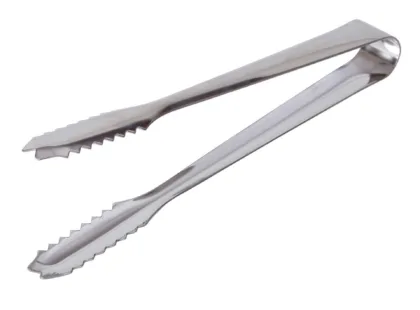
Hands are the other route in. The guidance puts it flatly: “hands should never be used”. It adds that you should not let customers put their hands in the ice either. Use a scoop or tongs shaped so the back of the hand and fingers cannot touch what they are lifting.
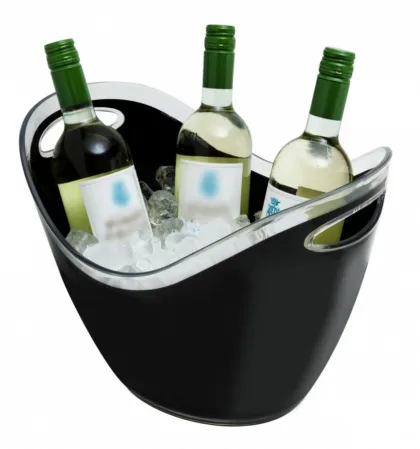
Ice also travels one way. Once it has left the machine it does not go back in, and the storage compartment is not a fridge. Guidance is to “never use storage compartment or ice buckets to cool or store anything except ice”, which rules out the bottles of wine chilling in the bin that everyone has seen at least once.
The same discipline applies across the bar. If you want the equivalent for glassware, our glasswasher cleaning and maintenance guide covers the routine on that side.
What an Environmental Health Officer Will Look At
Ice machines are inspected as part of routine food hygiene visits, and the questions are predictable.
| What they look at | What answers it |
|---|---|
| Condition of the bin and evaporator | Visible cleanliness: no biofilm, cloudiness or sediment |
| Where the scoop lives | A clean covered container, not the ice |
| Water supply | Mains-fed, potable, with the right backflow protection |
| How ice is handled | Staff using scoops or tongs, never hands |
| Your cleaning frequency | A written schedule and dated records showing you follow it |
The last row is the one people are least prepared for. Because the regulation asks for a frequency sufficient to avoid contamination rather than a set interval, an inspector cannot check you against a published number. They check you against your own documented schedule and whether the machine’s condition suggests it is working.
A clean machine with no records makes for a harder conversation than a clean machine with a signed sheet on the wall.
Putting It in Your Food Safety Management System
Because ice is food and the machine is food equipment, the ice machine belongs in the HACCP-based food safety management system you already keep, rather than in a separate maintenance folder.
That means a written cleaning schedule naming the machine, the intervals you have chosen, the products used, and who signs it off. It means recording each clean, descale and filter change with a date. And it means being able to say, if asked, why you clean at the interval you do: the manual said this, our water is hard, we run heavy volume in summer, so we shortened it.
If a machine is on rental, servicing is usually the supplier’s responsibility, but the daily hygiene routine (buckets, scoops, handling) stays with the venue. Worth being clear internally about which side owns what.
Frequently Asked Questions
Is ice classed as food in the UK?
Yes. The Food Safety Act 1990 takes its definition from Regulation (EC) 178/2002, which includes drink and water intentionally incorporated into food. Ice made for drinks is food, and the machine is food equipment.
How often does the law say to clean a commercial ice machine?
It does not specify an interval. Retained Regulation (EC) 852/2004 requires cleaning and disinfection “at a frequency sufficient to avoid any risk of contamination”, so the interval is yours to set from your manual, water hardness and usage, and yours to justify.
Does an ice machine need a WRAS-approved fitting?
An ice machine connection is Fluid Category 2 under the Water Supply (Water Fittings) Regulations 1999, which a single check valve protects. Using approved fittings is how you demonstrate compliance on anything plumbed into the mains.
What happens if an inspector finds a dirty ice machine?
Enforcement runs through the Food Safety and Hygiene (England) Regulations 2013 rather than section 8 of the Food Safety Act 1990, which was removed in 2005. Under regulation 19, offences carry a fine on summary conviction, and on indictment up to two years’ imprisonment, a fine, or both. In practice most cases start with advice or an improvement notice.
Getting the Machine Right in the First Place
Access decides how well a machine gets looked after. One jammed under a back-bar counter with no route to the bin will not get opened up as often as one you can reach.
If you are specifying or replacing, look at how the bin opens, whether the evaporator is reachable without tools, and whether there is a filter you can actually change.
Related resources
Guides:
- What is WRAS Approved?, what the certification covers and why it matters for mains-fed equipment
- How to Clean and Maintain Your Commercial Glasswasher, the equivalent routine for glassware
- Renting vs Buying Commercial Catering Equipment in the UK, the full decision guide
Equipment and service:
Sources
- Food Safety Act 1990, section 1, legislation.gov.uk (retrieved 21 Aug 2026)
- Food Safety Act 1990, section 8 — subsection (1) omitted with effect from 1 January 2005, legislation.gov.uk (retrieved 21 Aug 2026)
- Regulation (EC) No 178/2002, Article 2 (definition of “food”), legislation.gov.uk (retrieved 21 Aug 2026)
- Retained Regulation (EC) No 852/2004, Annex II, Chapters V and VII, legislation.gov.uk (retrieved 21 Aug 2026)
- Food Safety and Hygiene (England) Regulations 2013, regulation 19, legislation.gov.uk (retrieved 21 Aug 2026)
- East Cambridgeshire District Council, “Ice: Hygienic production and service” (retrieved 21 Aug 2026)
- South Staffs Water, Water Supply (Water Fittings) Regulations guidance — fluid categories and backflow protection (retrieved 21 Aug 2026)


